picture alliance / Contributor / Getty Images
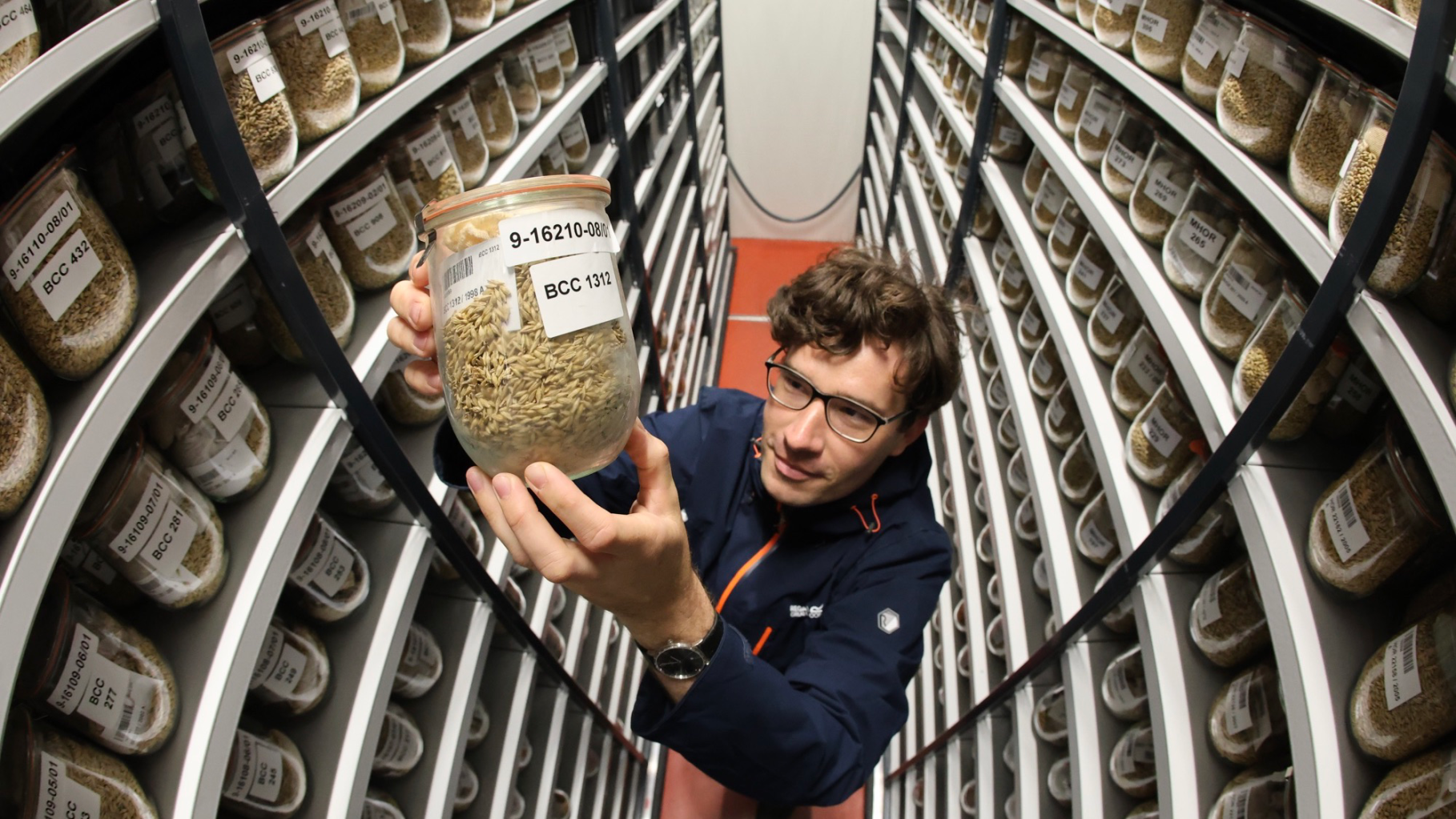
Amid the 872-day siege of Leningrad in the early 1940s, nine people died protecting a library. This library was not for books, but for seeds collected from around the globe. The nine who died were food scientists, starving to death alongside 700,000 of their neighbors. The library they were protecting was the world’s first seedbank, an ancestor to current-day genebanks worldwide. Genebanks are biorepositories used to store genetic material, like seeds and cells. Their origins came from a wanderlusting Russian plant-lover named Nikolai Vavilov………Continue reading…..
By: Julia Daye
Source: Popular Science
.
Critics:
Angiosperm seeds are “enclosed seeds”, produced in a hard or fleshy structure called a fruit that encloses them for protection. Some fruits have layers of both hard and fleshy material. In gymnosperms, no special structure develops to enclose the seeds, which begin their development “naked” on the bracts of cones. However, the seeds do become covered by the cone scales as they develop in some species of conifer.

Angiosperm (flowering plants) seeds consist of three genetically distinct constituents: (1) the embryo formed from the zygote, (2) the endosperm, which is normally triploid, (3) the seed coat from tissue derived from the maternal tissue of the ovule. In angiosperms, the process of seed development begins with double fertilization, which involves the fusion of two male gametes with the egg cell and the central cell to form the primary endosperm and the zygote.
Right after fertilization, the zygote is mostly inactive, but the primary endosperm divides rapidly to form the endosperm tissue. This tissue becomes the food the young plant will consume until the roots have developed after germination. Within the seed, there usually is a store of nutrients for the seedling that will grow from the embryo. The form of the stored nutrition varies depending on the kind of plant.
In angiosperms, the stored food begins as a tissue called the endosperm, which is derived from the mother plant and the pollen via double fertilization. It is usually triploid, and is rich in oil or starch, and protein. In gymnosperms, such as conifers, the food storage tissue (also called endosperm) is part of the female gametophyte, a haploid tissue. The endosperm is surrounded by the aleurone layer (peripheral endosperm), filled with proteinaceous aleurone grains.
Originally, by analogy with the animal ovum, the outer nucellus layer (perisperm) was referred to as albumen, and the inner endosperm layer as vitellus. Although misleading, the term began to be applied to all the nutrient matter. This terminology persists in referring to endospermic seeds as “albuminous”. The nature of this material is used in both describing and classifying seeds, in addition to the embryo to endosperm size ratio.
The endosperm may be considered to be farinaceous (or mealy) in which the cells are filled with starch, as for instance cereal grains, or not (non-farinaceous). The endosperm may also be referred to as “fleshy” or “cartilaginous” with thicker soft cells such as coconut, but may also be oily as in Ricinus (castor oil), Croton and Poppy. The endosperm is called “horny” when the cell walls are thicker such as date and coffee, or “ruminated” if mottled, as in nutmeg, palms and Annonaceae.
In most monocotyledons (such as grasses and palms) and some (endospermic or albuminous) dicotyledons (such as castor beans) the embryo is embedded in the endosperm (and nucellus), which the seedling will use upon germination. In the non-endospermic dicotyledons the endosperm is absorbed by the embryo as the latter grows within the developing seed, and the cotyledons of the embryo become filled with stored food.

At maturity, seeds of these species have no endosperm and are also referred to as exalbuminous seeds. The exalbuminous seeds include the legumes (such as beans and peas), trees such as the oak and walnut, vegetables such as squash and radish, and sunflowers. According to Bewley and Black (1978), Brazil nut storage is in hypocotyl and this place of storage is uncommon among seeds. All gymnosperm seeds are albuminous.Seeds serve several functions for the plants that produce them.
Key among these functions are nourishment of the embryo, dispersal to a new location, and dormancy during unfavorable conditions. Seeds fundamentally are means of reproduction, and most seeds are the product of sexual reproduction which produces a remixing of genetic material and phenotype variability on which natural selection acts. Plant seeds hold endophytic microorganisms that can perform various functions, the most important of which is protection against disease.
Seed germination is a process by which a seed embryo develops into a seedling. It involves the reactivation of the metabolic pathways that lead to growth and the emergence of the radicle or seed root and plumule or shoot. The emergence of the seedling above the soil surface is the next phase of the plant’s growth and is called seedling establishment.
Three fundamental conditions must exist before germination can occur. (1) The embryo must be alive, called seed viability. (2) Any dormancy requirements that prevent germination must be overcome. (3) The proper environmental conditions must exist for germination. Far red light can prevent germination. Seed viability is the ability of the embryo to germinate and is affected by a number of different conditions.
Some plants do not produce seeds that have functional complete embryos, or the seed may have no embryo at all, often called empty seeds. Predators and pathogens can damage or kill the seed while it is still in the fruit or after it is dispersed. Environmental conditions like flooding or heat can kill the seed before or during germination.
The age of the seed affects its health and germination ability: since the seed has a living embryo, over time cells die and cannot be replaced. Some seeds can live for a long time before germination, while others can only survive for a short period after dispersal before they die.


Leave a Reply