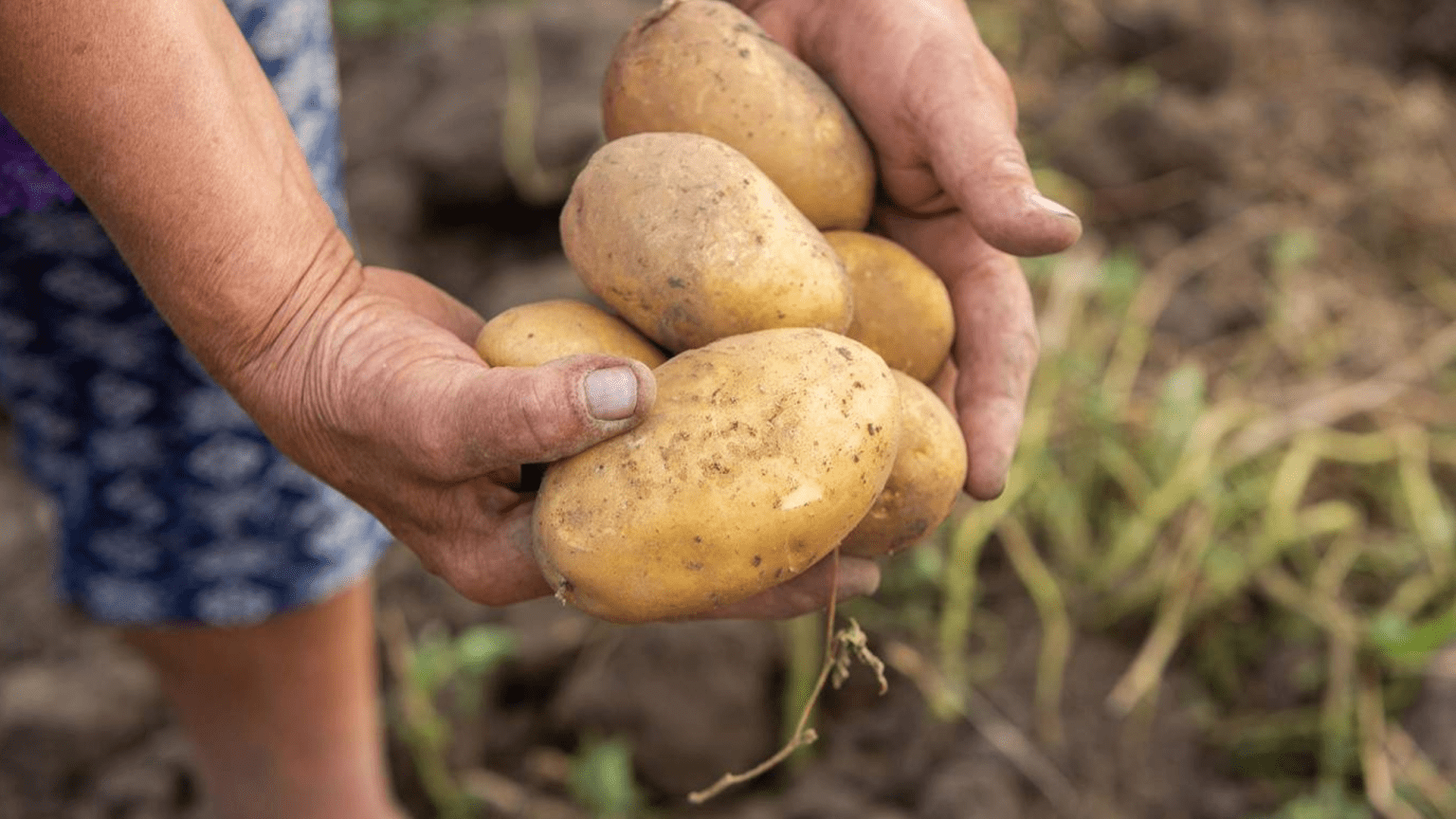
Image: University of Buffalo
Now a dietary staple around the world, the nutritious potato was first domesticated by the Indigenous peoples of the Andes around 10,000 years ago. It turns out that spuds played such a central role in their diets that their bodies adapted to process the versatile tuber more efficiently. Today, their ancestors have the highest number of genes linked to starch digestion in the world. A study published in the journal Nature Communications, analyzed levels of the AMY1 gene in 3,723 individuals from 85 global populations in genomic databases……..Continue reading..
By: Sara Hashemi
Source: Popular Science
.
Critics:
Potato plants are herbaceous perennials that grow up to one metre (three feet) high. The stems are hairy. The leaves have roughly four pairs of leaflets. The flowers range from white or pink to blue or purple; they are yellow at the centre, and are insect-pollinated. The plant develops tubers to store nutrients. These are not roots but stems that form from thickened rhizomes at the tips of long thin stolons.
On the surface of the tubers there are “eyes,” which act as sinks to protect the vegetative buds from which the stems originate. The “eyes” are arranged in helical form. In addition, the tubers have small holes that allow breathing, called lenticels. The lenticels are circular and their number varies depending on the size of the tuber and environmental conditions. Tubers form in response to decreasing day length, although this tendency has been minimized in commercial varieties.

After flowering, potato plants produce small green fruits that resemble green cherry tomatoes, each containing about 300 very small seeds. Potatoes, both S. tuberosum and most of its wild relatives, are self-incompatible: they bear no useful fruit when self-pollinated. This trait is problematic for crop breeding, as all sexually produced plants must be hybrids. The gene responsible for self-incompatibility, as well as mutations to disable it, are now known.
Self-compatibility has successfully been introduced both to diploid potatoes (including a special line of S. tuberosum) by CRISPR-Cas9. Plants having a ‘Sli’ gene produce pollen which is compatible to its own parent and plants with similar S genes. This gene was cloned by Wageningen University and Solynta in 2021, which would allow for faster and more focused breeding. Diploid hybrid potato breeding is a recent area of potato genetics supported by the finding that simultaneous homozygosity and fixation of donor alleles is possible.
Wild potato species useful for breeding blight resistance include Solanum desmissum and S. stoloniferum, among others. Genetic research has produced several genetically modified varieties. ‘New Leaf’, owned by Monsanto Company, incorporates genes from Bacillus thuringiensis (source of most Bt toxins in transcrop use), which confers resistance to the Colorado potato beetle; ‘New Leaf Plus’ and ‘New Leaf Y’, approved by US regulatory agencies during the 1990s, also include resistance to viruses. McDonald’s, Burger King, Frito-Lay, and Procter & Gamble announced they would not use genetically modified potatoes, and Monsanto published its intent to discontinue the line in March 2001.
Potato starch contains two types of glucan, amylose and amylopectin, the latter of which is most industrially useful. Waxy potato varieties produce waxy potato starch, which is almost entirely amylopectin, with little or no amylose. BASF developed the ‘Amflora’ potato, which was modified to express antisense RNA to inactivate the gene for granule bound starch synthase, an enzyme which catalyzes the formation of amylose.
‘Amflora’ potatoes therefore produce starch consisting almost entirely of amylopectin, and are thus more useful for the starch industry. In 2010, the European Commission cleared the way for ‘Amflora’ to be grown in the European Union for industrial purposes only—not for food. Nevertheless, under EU rules, individual countries have the right to decide whether they will allow this potato to be grown on their territory.
Commercial planting of ‘Amflora’ was expected in the Czech Republic and Germany in the spring of 2010, but due to lack of acceptance BASF in 2012 stopped selling the variety in Europe. Potato growth can be divided into five phases. During the first phase, sprouts emerge from the seed potatoes and root growth begins. During the second, photosynthesis begins as the plant develops leaves and branches above-ground and stolons develop from lower leaf axils on the below-ground stem.
In the third phase the tips of the stolons swell, forming new tubers, and the shoots continue to grow, with flowers typically developing soon after. Tuber bulking occurs during the fourth phase, when the plant begins investing the majority of its resources in its newly formed tubers. At this phase, several factors are critical to a good yield: optimal soil moisture and temperature, soil nutrient availability and balance, and resistance to pest attacks. The fifth phase is the maturation of the tubers: the leaves and stems senesce and the tuber skins harden.
New tubers may start growing at the surface of the soil. Since exposure to light leads to an undesirable greening of the skins and the development of solanine as a protection from the sun’s rays, growers cover surface tubers. Commercial growers cover them by piling additional soil around the base of the plant as it grows (called “hilling” up, or in British English “earthing up”). An alternative method, used by home gardeners and smaller-scale growers, involves covering the growing area with mulches such as straw or plastic sheets.

 Online Marketing Scoops
Leave a Reply