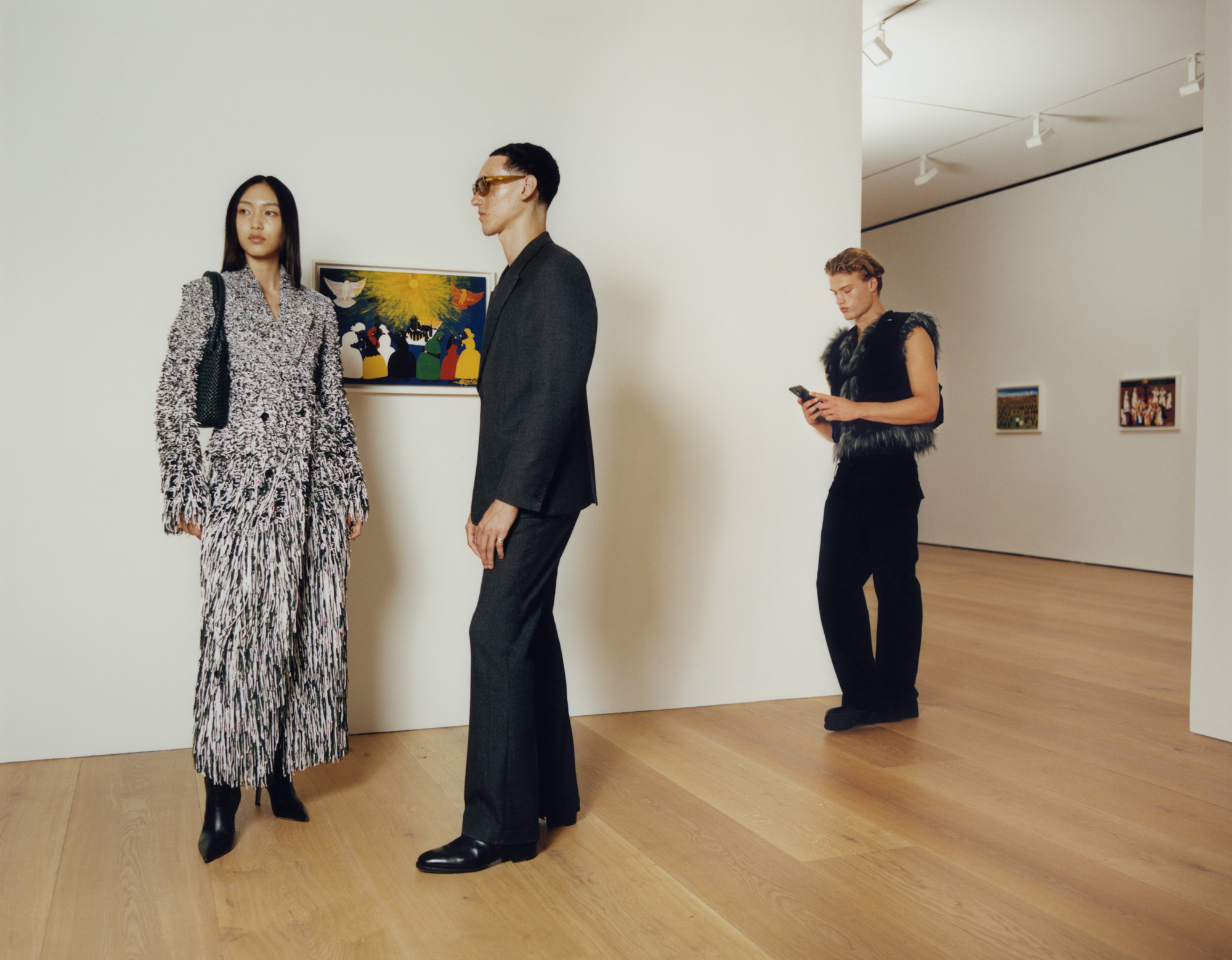
Image credit: Photography by Dham Srifuengfung, fashion by Jason Hughes
The symbiosis of art and fashion is well-documented and nowhere is this more evident than at Frieze’s various international editions, whereby the arrival of the contemporary art fair also heralds a slew of activations from fashion houses and brands as they seek to capitalise on the week’s cultural capital (and, indeed, high-spending clientele – it is often said that Frieze is like fashion week with more expensive handbags). That said, this year’s Frieze London, which arrives in the capital this week (14-18 October), is noticeably lighter on such crossovers, paving the way for more meaningful partnerships between fashion and art……….Continue reading…
By Jack Moss
Source: Wallpaper
.
Critics:
Fashion is a term used to describe the creation of clothing, footwear, accessories, cosmetics, and jewellery of different cultural aesthetics and their mix and match into outfits that depict distinctive ways of dressing (styles and trends) as signifiers of social status, self-expression, and group belonging. As a multifaceted term, fashion describes an industry, designs, aesthetics, and trends.
The term fashion originates from the Latin word facere, which means “to make”, and describes the manufacturing, mixing, and wearing of outfits adorned with specific cultural aesthetics, patterns, motifs, shapes, and cuts, allowing people to showcase their group affiliations, values, meanings, beliefs, and ways of life.

Given the rise in mass production of commodities and clothing at lower prices and global reach, reducing fashion’s environmental impact and improving sustainability have become urgent concerns an urgent issue among politicians, brands, and consumers. The world’s three leading fashion capitals currently are recognised to be New York City (Manhattan), Paris, and Milan, which are all headquarters to the most significant fashion companies and are renowned for their major influence on global fashion.
The annual Met Gala held at the Metropolitan Museum of Art in Manhattan is widely considered to be the world’s apex display of fashion’s power, wealth, and influence. In some fashion circles, Tokyo, London, and Los Angeles are also considered as second-tier fashion centers. Fashion weeks are held in these cities, where designers exhibit their new clothing collections to audiences.
A study demonstrated that general proximity to Manhattan’s Garmen.t District was important to participate in the American fashion ecosystem However, fashion has also migrated online to a significant extent, such that the geographical importance of cities as fashion capitals, while still centrally important, has become less so with the advent of artificial intelligence. Haute couture has now largely been spread alongside the sale of ready-to-wear collections and perfume using the same branding.
Fashion is also a source of art, allowing people to display their unique tastes, sensibilities, and styles. Different fashion designers are influenced by outside stimuli and reflect this inspiration in their work. For example, Gucci’s ‘stained green’ jeans may look like a grass stain, but to others, they display purity, freshness, and summer. Fashion is unique, self-fulfilling and may be a key part of someone’s identity.
Similarly to art, the aims of a person’s choices in fashion are not necessarily to be liked by everyone, but instead to be an expression of personal taste. A person’s personal style functions as a “societal formation always combining two opposite principles. It is a socially acceptable and secure way to distinguish oneself from others and, at the same time, it satisfies the individual’s need for social adaptation and imitation.”
While philosopher Immanuel Kant believed that fashion “has nothing to do with genuine judgements of taste”, and was instead “a case of unreflected and ‘blind’ imitation”, sociologist Georg Simmer thought of fashion as something that “helped overcome the distance between an individual and his society”. American sociologist Diana Crane also mentioned in her book that fashion is closely intertwined with personal and group identity, serving as a means of expressing cultural, social, and political affiliations.
Even though the terms fashion, clothing and costume are often used together, fashion differs from both. Clothing describes the material and the technical garment, devoid of any social meaning or connections; costume has come to mean fancy dress or masquerade wear. Fashion, by contrast, describes the social and temporal system that influences and “activates” dress as a social signifier in a certain time and context.
Philosopher Giorgio Agamben connects fashion to the qualitative Ancient Greek concept of kairos, meaning “the right, critical, or opportune moment”, and clothing to the quantitative concept of chronos, the personification of chronological or sequential time.



Leave a Reply