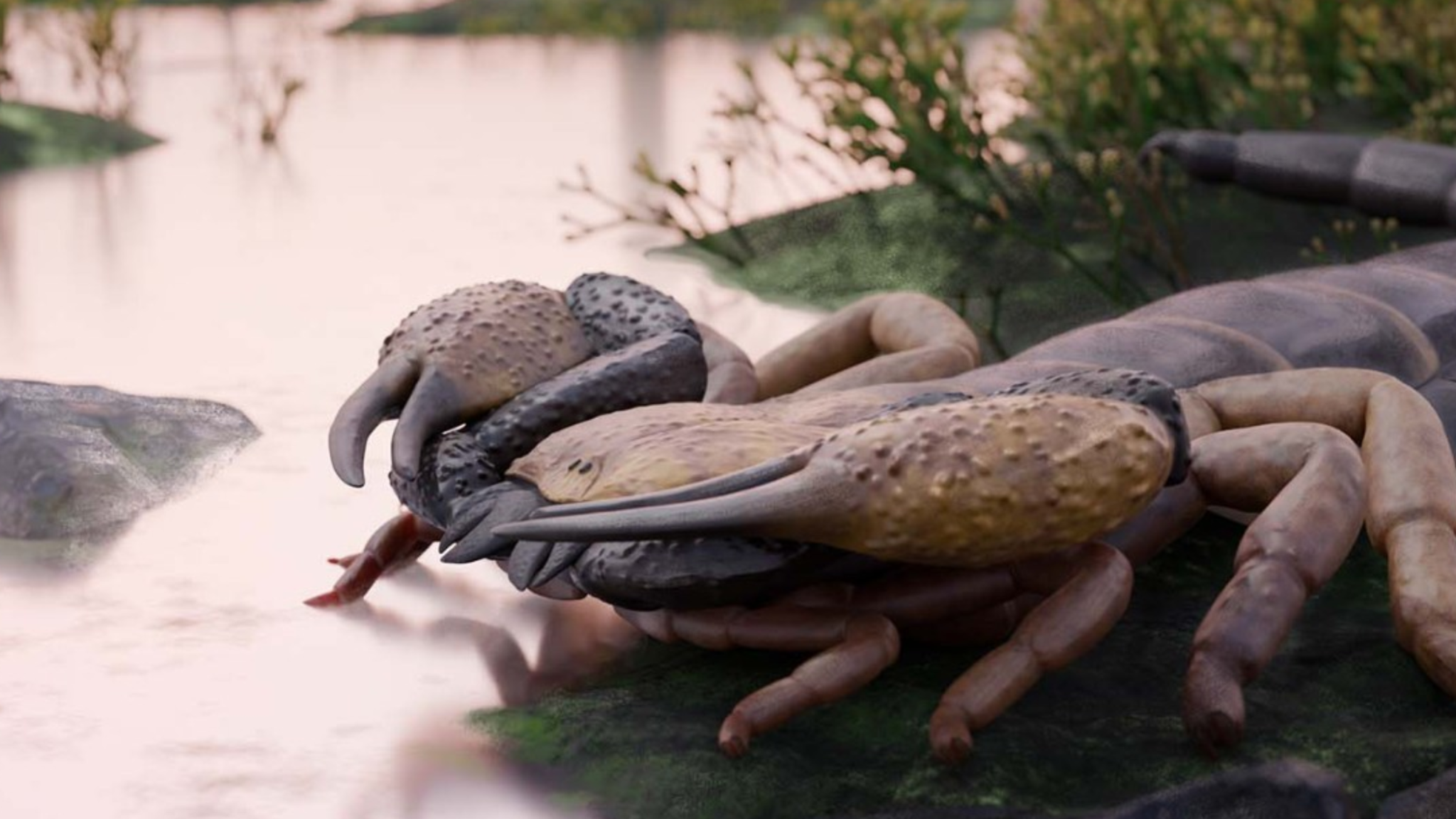
Credit: © Franz Anthony
Long before mammals, reptiles, or birds roamed Earth’s surface, another predator stalked the floodplains. It wasn’t a dinosaur… it was a scorpion. And not a small one, either. Fossils of the creature dating to around 415 million years ago from the UK were first described back in the 1870s, and since then, scientists have been arguing over what exactly they were looking at. A recent analysis published in the journal Palaeontology – using CT scans combined with old-school camera lucida tracings – has settled it. The creature is called Praearcturus gigas, and it may be the biggest scorpion ever to have lived……….Continue reading….
Source: ScienceAlert
.
Critics:
Scorpions (order Scorpiones) are predatory arachnids with eight legs, a pair of grasping pincers and a narrow, segmented tail, often carried in a characteristic forward curve over the back and always ending with a stinger. The evolutionary history of scorpions goes back to the Silurian Period, approximately 430 million years ago.
They mainly live in deserts but have adapted to a wide range of environmental conditions, and can be found on all continents except Antarctica. There are over 2,500 described species, with 22 extant (living) families recognized to date. Their taxonomy is being revised to account for 21st-century genomic studies.

Scorpions primarily prey on insects and other invertebrates, but some species hunt vertebrates. They use their pincers to restrain and kill prey, or to prevent their own predation. The scorpion’s sting is venomous and used for offense and defense. During courtship, the male and female grasp each other’s pincers and dance while the male tries to move the female onto his sperm packet.
All known species give live birth and the female cares for the young as their exoskeletons harden, transporting them on her back. The exoskeleton contains fluorescent chemicals and glows under ultraviolet light. The vast majority of species do not seriously threaten humans, and healthy adults usually do not need medical treatment after a sting.
About 25 species (fewer than one percent) have venom capable of killing a human, which happens frequently in the parts of the world where they live, primarily where access to medical treatment is unlikely. Scorpions appear in art, folklore, mythology, and commercial brands. Scorpion motifs are woven into kilim carpets for protection from their sting. Scorpius is the name of a constellation; the corresponding astrological sign is Scorpio.
A classical myth about Scorpius tells how the giant scorpion and its enemy Orion became constellations on opposite sides of the sky. The word scorpion originated in Middle English between 1175 and 1225 AD from Old French scorpion, or from Italian scorpione, both derived from the Latin scorpio, equivalent to scorpius, which is the romanization of the Greek σκορπίος skorpíos.
Scorpion fossils have been found in many strata, including marine Silurian and estuarine Devonian deposits, coal deposits from the Carboniferous Period and in amber. Whether the early scorpions were marine or terrestrial has been debated, and while they had book lungs like modern terrestrial species,the most basal such as Eramoscorpius were originally considered as still aquatic, until it was found that Eramoscorpius had book lungs.
Over 100 fossil species of scorpion have been described. The oldest found as of 2021 is Dolichophonus loudonensis, which lived during the Silurian, in present-day Scotland. Gondwanascorpio from the Devonian is among the earliest-known terrestrial animals on the Gondwana supercontinent. Some Palaeozoic scorpions possessed compound eyes similar to those of eurypterids.
The Triassic fossils Protochactas and Protobuthus belong to the modern clades Chactoidea and Buthoidea respectively, indicating that the crown group of modern scorpions had emerged by this time. In 2025, a 140 million year old scorpion was discovered in Jordanian amber by Abbas Haddadin.
Carl Linnaeus described six species of scorpion in his genus Scorpio in 1758 and 1767; three of these are now considered valid and are called Scorpio maurus, Androctonus australis, and Euscorpius carpathicus; the other three are dubious names. He placed the scorpions among his “Insecta aptera” (wingless insects).
In 1801, Jean-Baptiste Lamarck divided up the “Insecta aptera”, creating the taxon Arachnides for spiders, scorpions, and acari (mites and ticks), though it also contained the Thysanura, Myriapoda and parasites such as lice. German arachnologist Carl Ludwig Koch created the order Scorpiones in 1837.
He divided it into four families, the six-eyed scorpions “Scorpionides”, the eight-eyed scorpions “Buthides”, the ten-eyed scorpions “Centrurides”, and the twelve-eyed scorpions “Androctonides”. More recently, some twenty-two families containing over 2,500 species of scorpions have been described, with many additions and much reorganization of taxa in the 21st century. There are over 100 described taxa of fossil scorpions.



Leave a Reply