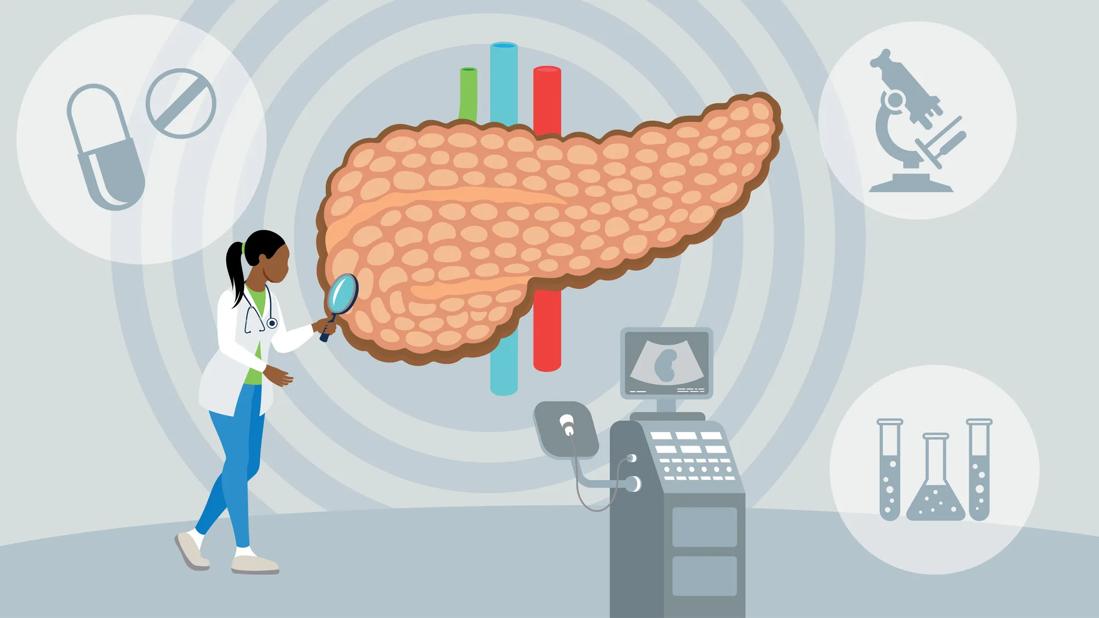
In its early stages, the disease rarely causes symptoms but as it progresses, it can cause jaundice, stomach pain, mid-back pain, vomiting and more. Pancreatic cancer is difficult to detect. And it’s usually found at advanced stages. That’s why it’s important to know the signs and to talk to your healthcare provider as soon as you notice changes in your health. Oncologist Suneel Kamath, MD, shares what you need to know about the possible symptoms of pancreatic cancer…….Continue reading…
Source: Cleveland Clinic
.
Critics:
Pancreatic cancer is any cancer with a primary location in the pancreas, a glandular organ lying behind the stomach. It arises when cells in the pancreas start to multiply out of control and form a mass. These cancerous cells have the ability to invade or spread to other parts of the body. A number of types of pancreatic cancer are known.

The most common type of pancreatic cancer, pancreatic adenocarcinoma, accounts for about 90% of cases, and the term “pancreatic cancer” is sometimes used to refer only to that type. These adenocarcinomas start within the ductal part of the pancreas that makes digestive enzymes. Several other types of cancer, which collectively represent the majority of the non-adenocarcinomas, can also arise from these cells.
About 1–2% of cases of pancreatic cancer are neuroendocrine tumors, which arise from the hormone-producing cells of the pancreas. These are generally less aggressive than pancreatic adenocarcinoma. Signs and symptoms of the most-common form of pancreatic cancer may include yellow skin, abdominal or back pain, unexplained weight loss, light-colored stools, dark urine, and loss of appetite.
Usually, no symptoms are seen in the disease’s early stages, and symptoms that are specific enough to suggest pancreatic cancer typically do not develop until the disease has reached an advanced stage. By the time of diagnosis, pancreatic cancer has often spread to other parts of the body. Pancreatic cancer rarely occurs before the age of 40, and more than half of cases of pancreatic adenocarcinoma occur in those over 70.
However, early-onset pancreatic cancer (defined as pancreatic cancer diagnosed in someone <50 years of age) is becoming more prevalent, disproportionally so in younger women. Risk factors for pancreatic cancer include tobacco smoking, obesity, diabetes, and certain rare genetic conditions. About 25% of cases are linked to smoking, and 5–10% are linked to inherited genes.
Pancreatic cancer is usually diagnosed by a combination of medical imaging techniques such as ultrasound or computed tomography, blood tests, and examination of tissue samples (biopsy). The disease is divided into stages, from early (stage I) to late (stage IV). Screening the general population has not been found to be effective.
The risk of developing pancreatic cancer is lower among non-smokers, and people who maintain a healthy weight and limit their consumption of red or processed meat; the risk is greater for men, smokers, and those with diabetes. There are some studies that link high levels of red meat consumption to increased risk of pancreatic cancer, though meta-analyses typically find no clear evidence of a relationship.
Smokers’ risk of developing the disease decreases immediately upon quitting, and almost returns to that of the rest of the population after 20 years. Pancreatic cancer can be treated with surgery, radiotherapy, chemotherapy, palliative care, or a combination of these.Treatment options are partly based on the cancer stage. Surgery is the only treatment that can cure pancreatic adenocarcinoma, and may also be done to improve quality of life without the potential for cure.

Pain management and medications to improve digestion are sometimes needed. Early palliative care is recommended even for those receiving treatment that aims for a cure. Pancreatic cancer is among the most deadly forms of cancer globally, with one of the lowest survival rates. In 2021, pancreatic cancers of all types resulted in 508,532 (up from 411,600 in 2013) deaths globally. It is the fifth-most-common cause of death from cancer in the United Kingdom, and the third most-common in the United States.
The disease occurs most often in the developed world, where about 70% of the new cases in 2012 originated Pancreatic adenocarcinoma typically has a very poor prognosis; after diagnosis, 9% survive after 5 years globally and 14% live for five years in the US. For cancers diagnosed early, the five-year survival rate rises to about 20%. Neuroendocrine cancers have better outcomes; at five years from diagnosis, 65% of those diagnosed are living, though survival considerably varies depending on the type of tumor.
The many types of pancreatic cancer can be divided into two general groups. The vast majority of cases (about 95%) occur in the part of the pancreas that produces digestive enzymes, known as the exocrine component. Several subtypes of exocrine pancreatic cancers are described, but their diagnosis and treatment have much in common.
The small minority of cancers that arise in the hormone-producing (endocrine) tissue of the pancreas have different clinical characteristics and are called pancreatic neuroendocrine tumors, sometimes abbreviated as “PanNETs”. Both groups occur mainly (but not exclusively) in people over 40, and are slightly more common in men, but some rare subtypes mainly occur in women or children.
The small minority of tumors that arise elsewhere in the pancreas are mainly pancreatic neuroendocrine tumors (PanNETs). Neuroendocrine tumors (NETs) are a diverse group of benign or malignant tumors that arise from the body’s neuroendocrine cells, which are responsible for integrating the nervous and endocrine systems. NETs can start in most organs of the body, including the pancreas, where the various malignant types are all considered to be rare.
PanNETs are grouped into ‘functioning’ and ‘nonfunctioning’ types, depending on the degree to which they produce hormones. The functioning types secrete hormones such as insulin, gastrin, and glucagon into the bloodstream, often in large quantities, giving rise to serious symptoms such as low blood sugar, but also favoring relatively early detection. The most common functioning PanNETs are insulinomas and gastrinomas, named after the hormones they secrete.
The nonfunctioning types do not secrete hormones in a sufficient quantity to give rise to overt clinical symptoms, so nonfunctioning PanNETs are often diagnosed only after the cancer has spread to other parts of the body. As with other neuroendocrine tumors, the history of the terminology and classification of PanNETs is complex. PanNETs are sometimes called “islet cell cancers”, though they are now known to not actually arise from islet cells as previously thought.



Leave a Reply