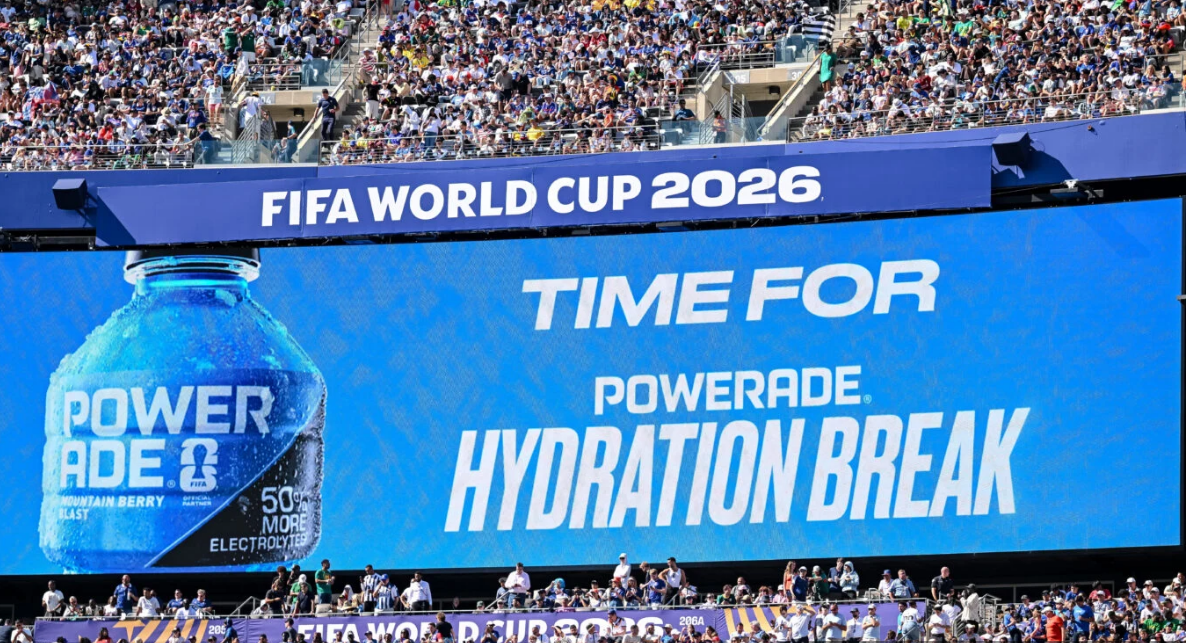
Harry Langer/DeFodi Images/DeFodi via Getty Images
FIFA has brought in mandatory three-minute stoppages around the middle of each half during a summer tournament across North America. The pauses give players time to cool down, but they also give coaches a built-in chance to regroup, reset shape and break the rhythm of the team in control. That is why the criticism is now moving beyond complaints about flow and into a wider debate about whether the breaks are affecting results…….Continue reading…
Source: HITC
.
Critics:
Virtually any medium can be used for advertising. Commercial advertising media can include wall paintings, billboards, street furniture components, printed flyers and rack cards, radio, cinema and television adverts, web banners, mobile telephone screens, shopping carts, web popups, skywriting, bus stop benches, human billboards and forehead advertising, magazines, newspapers, town criers, sides of buses, banners attached to airplanes (“logojets”)…
In-flight advertisements on seatback tray tables or overhead storage, taxicab doors, roof mounts and passenger screens, musical stage shows, subway platforms and trains, elastic bands on disposable diapers, doors of bathroom stalls, stickers on fruit in supermarkets, shopping cart handles (grabertising), in streaming audio and video, posters, and on event tickets and supermarket receipts. Any situation in which an “identified” sponsor pays to deliver their message through a medium is advertising.
Billboards, also known as hoardings in some parts of the world, are large structures located in public places which display advertisements to passing pedestrians and motorists. Most often, they are located on main roads with a large amount of passing motor and pedestrian traffic; however, they can be placed in any location with large numbers of viewers, such as on mass transit vehicles and in stations, in shopping malls or office buildings, and in stadiums.
Street advertising involves creating outdoor advertising on street furniture and pavements and can use products such as Reverse Graffiti, air dancers and 3D pavement advertising. Sheltered outdoor advertising combines outdoor with indoor advertisement by placing large mobile structures (tents) in public places on a temporary basis. The large outer advertising space aims to entice the observer in, with the product promoted inside.
Mobile billboards are generally vehicle mounted billboards or digital screens. These can be on dedicated vehicles built solely for carrying advertisements and can travel along routes preselected by advertisers. They can also be specially equipped cargo trucks or, in some cases, large banners strewn from planes. Billboards are often lighted; some being backlit, and others employing spotlights. Some billboard displays are static, while others change; for example, continuously or periodically rotating a set of advertisements.
Mobile displays are used for various situations in metropolitan areas throughout the world, including: target advertising, one-day and long-term campaigns, conventions, sporting events, store openings and similar promotional events, and advertisements from smaller companies. The concept of crowdsourcing has given way to the trend of user-generated advertisements.
User-generated ads are created by people, as opposed to an advertising agency or the company themselves, often resulting from brand sponsored advertising competitions. For the 2007 Super Bowl, the Frito-Lays division of PepsiCo held the “Crash the Super Bowl” contest, allowing people to create their own Doritos commercials. Chevrolet held a similar competition for their Tahoe line of SUVs.
Due to the success of the Doritos user-generated ads in the 2007 Super Bowl, Frito-Lays relaunched the competition for the 2009 and 2010 Super Bowl. The resulting ads were among the most-watched and most-liked Super Bowl ads. In fact, the winning ad that aired in the 2009 Super Bowl was ranked by the USA Today Super Bowl Ad Meter as the top ad for the year while the winning ads that aired in the 2010 Super Bowl were found by Nielsen’s BuzzMetrics to be the “most buzzed-about”.

Another example of companies using crowdsourcing successfully is the beverage company Jones Soda that encourages consumers to participate in the label design themselves. This trend has given rise to several online platforms that host user-generated advertising competitions on behalf of a company.
Founded in 2007, Zooppa has launched ad competitions for brands such as Google, Nike, Hershey’s, General Mills, Microsoft, NBC Universal, Zinio, and Mini Cooper. Crowdsourcing remains controversial, as the long-term impact on the advertising industry is still unclear.



Leave a Reply