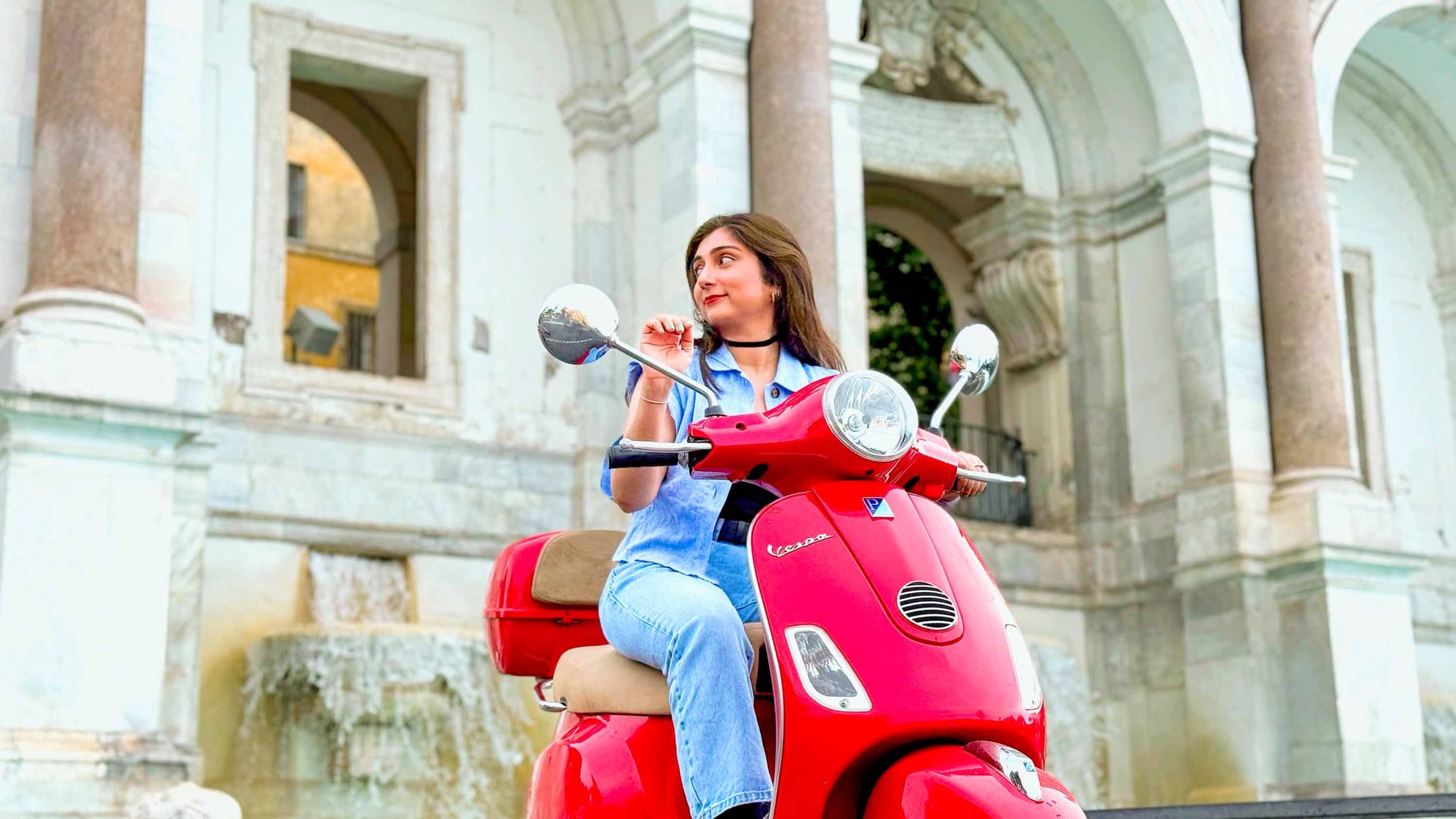
The smell of freshly cooked pizza fills the air as I whizz past trattorias scattered around Trastevere, Rome’s trendiest neighborhood, on my rented shiny red Vespa. It’s just before rush hour, but people are already spilling out onto the cobbled streets, Aperol Spritzes in hand, gathering outside courtyards and Trastevere’s iconic orange buildings as conversations drift through shuttered windows……Continue reading…
By: Queenie Shaikh
Source: Adventure.com
.
Critics:
In 1944 Piaggio engineers Renzo Spolti and Vittorio Casini designed a motorcycle with bodywork fully enclosing the drivetrain and forming a tall splash guard at the front. In addition to the bodywork, the design included handlebar-mounted controls, forced air cooling, wheels of small diameter, and a tall central section that had to be straddled. Officially known as the MP5 (“Moto Piaggio no. 5”), the prototype was nicknamed “Paperino” (meaning “Donald Duck” in Italian).

Piaggio was displeased with the MP5, especially the tall central section. He contracted aeronautical engineer Corradino D’Ascanio, to redesign the scooter. D’Ascanio, who had earlier been consulted by Ferdinando Innocenti about scooter design and manufacture, made it immediately known that he hated motorcycles, believing them to be bulky, dirty, and unreliable. D’Ascanio’s MP6 prototype had its engine mounted beside the rear wheel. The wheel was driven directly from the transmission, eliminating the drive chain and the oil and dirt associated with it.
The prototype had a unit spar frame with stress-bearing steel outer panels. These changes allowed the MP6 to have a step-through design instead of a tall centre section like that of the MP5 Paperino. The MP6 design also included a single-sided front suspension, interchangeable front and rear wheels mounted on stub axles, and a spare wheel. Other features of the MP6 were similar to those on the Paperino, including the handlebar-mounted controls and the enclosed bodywork with the tall front splash guard.
Upon seeing the MP6 for the first time, Enrico Piaggio exclaimed: “Sembra una vespa!” (“It looks like a wasp!”) Piaggio effectively named his new scooter on the spot. Vespa is both Latin and Italian for wasp—derived from the vehicle’s body shape: the thicker rear part connected to the front part by a narrow waist, and the steering rod resembled antennae. The Vespa 946 is a scooter announced by Piaggio, sold under their Vespa brand, that sold starting in July 2013. Piaggio presented the retro-futurist Vespa Quarantasei concept, based on the 1945 Vespa MP6 prototype, at the 2011 EICMA motorcycle show.
The final production version, renamed the Vespa 946, appeared the following year, at EICMA 2012. The 946 will be fitted with Piaggio’s new air-cooled, three-valve, single-cylinder engine, with a claimed output of 11.7 hp (8.7 kW) for the 125 cc (7.6 cu in) displacement version, and 13 hp (9.7 kW) for the 150 cc (9.2 cu in) version.
Vespa clubs popped up throughout Europe, and by 1952, worldwide Vespa Club membership had surpassed 50,000. By the mid-1950s, Vespas were being manufactured under licence in Germany, the United Kingdom, France, Belgium and Spain; in the 1960s, production was started in India, Brazil and Indonesia. By 1956, one million had been sold, then two million by 1960.
By the 1960s, the Vespa originally conceived as a utility vehicle—had come to symbolize freedom and imagination, and resulted in further sales boosts: four million by 1970, and ten million by the late 1980s. Improvements were made to the original design and new models were introduced. The 1948 Vespa 125 had rear suspension and a bigger engine. The headlamp was moved up to the handlebars in 1953 and had more engine power and a restyled rear fairing. A cheaper spartan version was also available.
One of the best-loved models was the Vespa 150 GS introduced in 1955 with a 150 cc engine, a long saddle, and the faired handlebar-headlamp unit. Then came the 50 cc of 1963, and in 1968 Vespa 125 Primavera became one of the most durable of all.




Leave a Reply