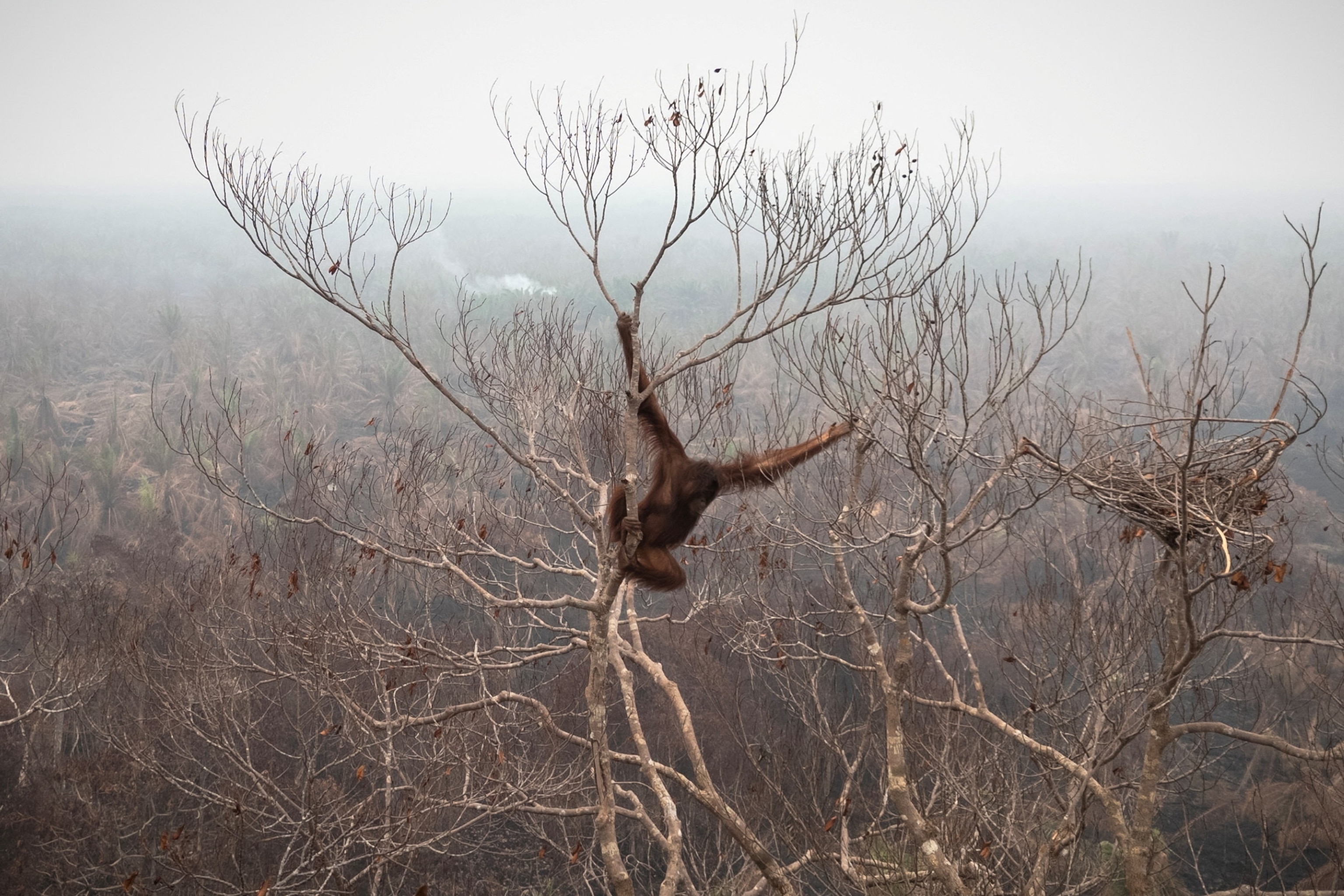
In late September, flames licked just 15 feet from the base of a slender sengon tree, its white bark beginning to darken from smoke and ash. Clinging to its thin branches was a young orangutan who had attempted to flee the forest fires that have ravaged Indonesia since July. The crackling and roar of the flames was “the sound of disaster,” says Jamartin Sihite, a conservation ecologist with the Borneo Orangutan Survival Foundation who was there with a team of veterinarians, firefighters, and other volunteers trying to save the orangutan……….Continue reading…
By Rebecca Dzombak
Source: National Geographic
.
Critics:
Orangutans are great apes native to the rainforests of Indonesia and Malaysia. They are now found only in parts of Borneo and Sumatra, but during the Pleistocene they ranged throughout Southeast Asia and South China. Classified in the genus Pongo, orangutans were originally considered to be one species.
In 1996, they were divided into two species: the Bornean orangutan (P. pygmaeus, with three subspecies) and the Sumatran orangutan (P. abelii); a third species, the Tapanuli orangutan (P. tapanuliensis), was identified definitively in 2017. The orangutans are the only surviving members of the subfamily Ponginae, which diverged genetically from the other hominids (gorillas, chimpanzees, and humans) between 19.3 and 15.7 million years ago.

The most arboreal of the great apes, orangutans spend most of their time in trees. They have proportionally long arms and short legs, and have reddish-brown hair covering their bodies. Dominant adult males develop distinctive cheek pads or flanges and make long calls that attract females and intimidate rivals; younger subordinate males do not and more resemble adult females.
Orangutans are the most solitary of the great apes: social bonds occur primarily between mothers and their dependent offspring. Fruit is the most important component of an orangutan’s diet, but they will also eat vegetation, bark, honey, insects and bird eggs. They can live over 30 years, both in the wild and in captivity.
Orangutans are among the most intelligent primates. They use a variety of sophisticated tools and construct elaborate sleeping nests each night from branches and foliage. The apes’ learning abilities have been studied extensively. There may be distinctive cultures within populations. Orangutans have been featured in literature and art since at least the 18th century, particularly in works that comment on human society.
Field studies of the apes were pioneered by primatologist Biruté Galdikas and they have been kept in captive facilities around the world since at least the early 19th century. All three orangutan species are considered critically endangered. Human activities have caused severe declines in populations and ranges.
Threats to wild orangutan populations include poaching (for bushmeat and retaliation for consuming crops), habitat destruction and deforestation (for palm oil cultivation, and logging), and the illegal pet trade. Several conservation and rehabilitation organisations are dedicated to the survival of orangutans in the wild.
Orangutans display significant sexual dimorphism; females typically stand 115 cm (45 in) tall and weigh around 37 kg (82 lb), while adult males stand 137 cm (54 in) tall and weigh 75 kg (165 lb). The tallest orangutan recorded was a 180 cm (71 in). Compared to humans, they have proportionally long arms, a male orangutan having an arm span of about 2 m (6 ft 7 in), and short legs.
They are covered in long reddish hair that starts out bright orange and darkens to maroon or chocolate with age, while the skin is grey-black. Males’ faces can develop a beard. Orangutans have small ears and noses; the ears are unlobed. The mean endocranial volume is 397 cm3. The cranium is elevated relative to the face, which is incurved and prognathous.
Compared to other great apes, the brow ridge of an orangutan is underdeveloped. Females and juveniles have relatively circular skulls and thin faces while mature males have a prominent sagittal crest, large cheek pads or flanges, extensive throat pouches and long canines. The cheek pads are made mostly of fatty tissue and are supported by the musculature of the face. The throat pouches act as resonance chambers for making long calls.
Orangutan hands have four long fingers but a dramatically shorter opposable thumb for a strong grip on branches as they travel high in the trees. The resting configuration of the fingers is curved, creating a suspensory hook grip. With the thumb out of the way, the fingers (and hands) can grip securely around objects with a small diameter by resting the tops of the fingers against the inside of the palm, thus creating a double-locked grip.
Their feet have four long toes and an opposable big toe, giving them hand-like dexterity. The hip joints also allow for their legs to rotate similarly to their arms and shoulders. Orangutans move through the trees by both vertical climbing and suspension. Compared to other great apes, they infrequently descend to the ground where they are more cumbersome. Unlike African apes, orangutans are not true knuckle-walkers, instead bending their digits and walking on the sides of their hands and feet.
Orangutans are primarily fruit-eaters, which can take up 57–80% of their foraging time. Even during times of scarcity, fruit is 16% of their feeding time. Fruits with soft pulp, arils or seed-walls are consumed the most, particularly figs but also drupes and berries. Orangutans are thought to be the sole fruit disperser for some plant species including the vine species Strychnos ignatii which contains the toxic alkaloid strychnine.
Orangutans also include leaves in their diet, which take up 25% of their average foraging time. Leaves are eaten more when fruit is less available, but even during times of fruit abundance, orangutans will eat leaves 11–20% of the time. They appear to depend on the leaf and stem material of Borassodendron borneensis during times of low fruit abundance. Other food items consumed by the apes include bark, honey, bird eggs, insects and small vertebrates including slow lorises.



Leave a Reply