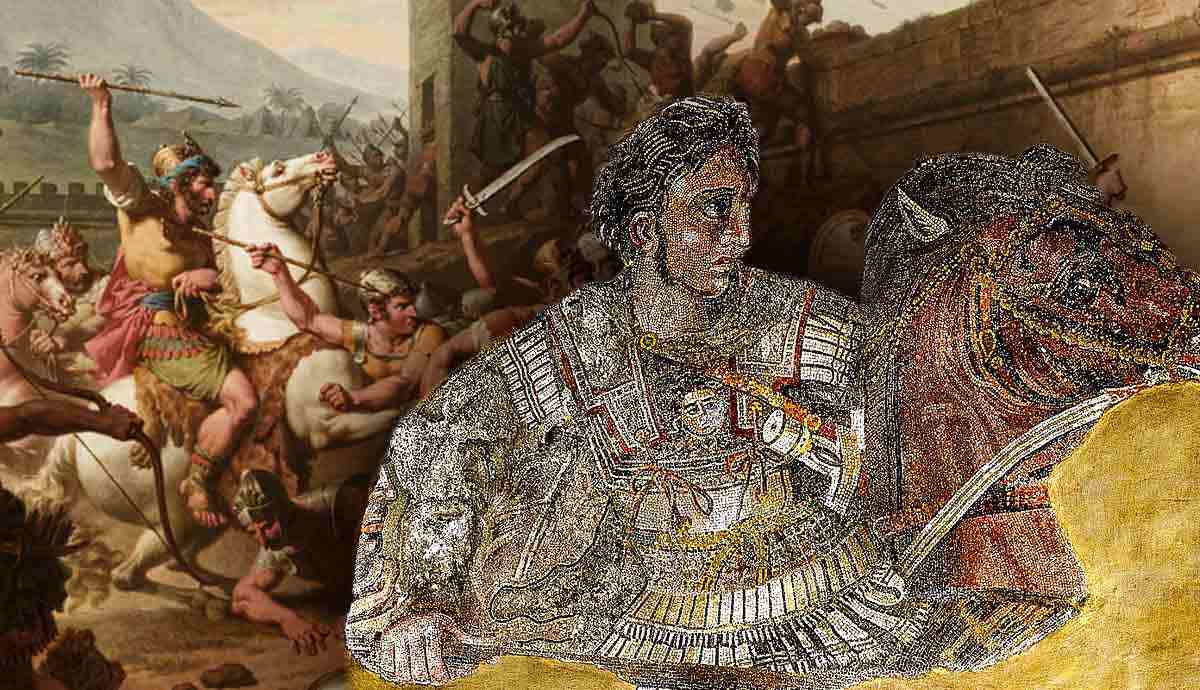
In the 4th century BC, Alexander of Macedon achieved the impossible. He conquered the largest empire the world had ever known, Persia, earning him the moniker “the Great.” Yet there were kingdoms further east, and Alexander had an insatiable desire to see the edge of the world. So he and his army marched on, beyond the Hindu Kush and into the Indus River Valley. He was opposed by local leaders and eventually challenged by King Porus. Alexander was victorious, reaching as far as the Hyphasis River. But he never crossed it. Instead, he turned south, marching home. Why did Alexander abandon his conquest of India?……..Continue reading…
By Daniel Soulard, BASc Classical Civilizations
Source: TheCollector
.
Critics:
Alexander’s invasion of Persia as a whole has been denoted as a supreme example of a “strategic line” of conducting war, a line formed by “the chain of logic that connects operations into a single whole.” In his book Strategy, Soviet military officer and theorist Alexander Svechin delineates Alexander’s strategic steps.
After securing his Greek base and the Balkans by subjugating his political opponents, and securing his army’s rear through the conquest of all the Afro-Asian coastline, where the Persian fleet was based and from which it was supplied, Alexander moved to confront directly the Persians. He thus resolved the eternal problem of an army conducting operations deep into enemy territory, Svechin states, in an “exemplary manner.

Alexander began his reign by eliminating potential rivals to the throne. He had his cousin, the former Amyntas IV, executed and two Macedonian princes from the region of Lyncestis killed for having been involved in his father’s assassination, but spared a third, Alexander Lyncestes. Olympias had Cleopatra Eurydice, and Europa, her daughter by Philip, burned alive, though this infuriated Alexander.
Alexander also ordered the murder of Cleopatra’s uncle Attalus, who was in command of the advance guard of the army in Asia Minor. Attalus was at that time corresponding with Demosthenes regarding the possibility of defecting to Athens, and had severely insulted Alexander. After his niece’s murder, Alexander may have considered him too dangerous to be left alive. Alexander spared Arrhidaeus, who was by all accounts mentally disabled, possibly as a result of poisoning by Olympias.
News of Philip’s death roused many states into revolt, including Thebes, Athens, Thessaly, and the Thracian tribes north of Macedon. When news of the revolts reached Alexander, he responded quickly. Though advised to use diplomacy, Alexander mustered 3,000 Macedonian cavalry and rode south towards Thessaly. He found the Thessalian army occupying the pass between Mount Olympus and Mount Ossa, and ordered his men to ride over Mount Ossa.
When the Thessalians awoke the next day, they found Alexander in their rear and promptly surrendered, adding their cavalry to Alexander’s force. He then continued south towards the Peloponnese. Alexander stopped at Thermopylae where he was recognized as the leader of the Amphictyonic League before heading south to Corinth. Athens sued for peace and Alexander pardoned the rebels. The famous encounter between Alexander and Diogenes the Cynic occurred during Alexander’s stay in Corinth.
When Alexander asked Diogenes what he could do for him, the philosopher disdainfully asked Alexander to stand a little to the side, as he was blocking the sunlight. This reply apparently delighted Alexander who is reported to have said, “But verily, if I were not Alexander, I would like to be Diogenes.” At Corinth, Alexander took the title of Hegemon (“leader”) and, like Philip, was appointed commander for the coming war against Persia. He also received news of a Thracian uprising.


Leave a Reply