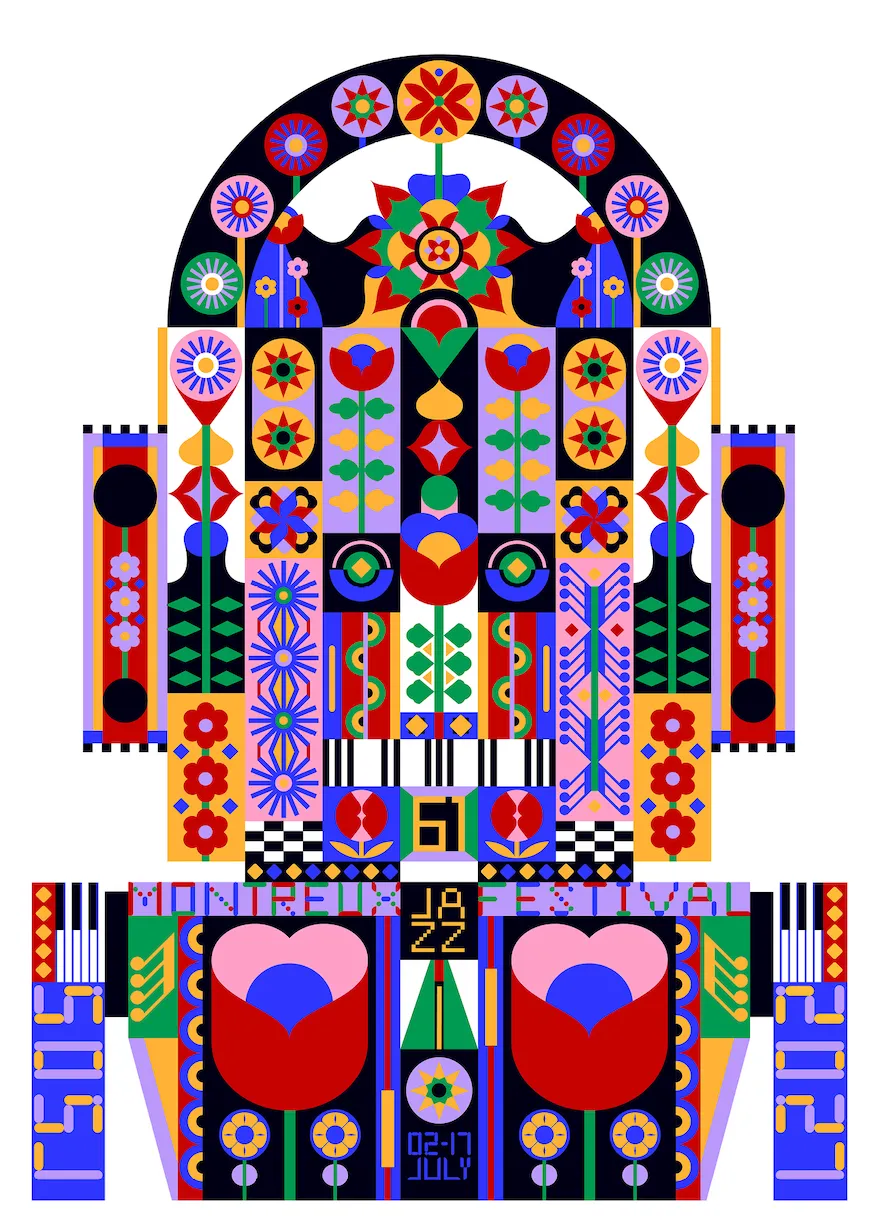
Image Credit: Montreux Jazz Festival
Montreux has a long history of artist-designed posters. Other previous contributors have included David Bowie, Jean Tinguely, Yoann Lemoine (Woodkid), Lakwena, Kévin Germanier and Christian Marclay. Keith Haring designed for the festival twice. For his second commission, in 1986, he worked with Andy Warhol as a collaborator. The festival invited Malika to adopt a similar approach for her second contribution, ten years after her first design for Montreux……..Continue reading….
By Joe Foley
Source: Creative Bloq
.
Critics:
According to the French historian Max Gallo, “For over two hundred years, posters have been displayed in public places all over the world. Visually striking, they have been designed to attract the attention of passers-by, making us aware of a political viewpoint, enticing us to attend specific events, or encouraging us to purchase a particular product or service.” The modern poster, as we know it, however, dates back to the mid-19th century, when several separate, but related, changes took place.
First, the printing industry perfected colour lithography and made mass production of large and inexpensive images possible. Second, government censorship of public spaces in countries such as France was lifted. And finally, advertisers began to market mass-produced consumer goods to a growing populace in urban areas.”

In little more than a hundred years”, writes poster expert John Barnicoat, “it has come to be recognized as a vital art form, attracting artists at every level, from painters such as Toulouse-Lautrec and Mucha to theatrical and commercial designers. They have ranged in styles from Art Nouveau, Symbolism, Cubism, and Art Deco to the more formal Bauhaus and the often incoherent hippie posters of the 1960s.
Posters, in the form of placards and posted bills, have been used since earliest times, primarily for advertising and announcements. Purely textual posters have a long history: they advertised the plays of Shakespeare and made citizens aware of government proclamations for centuries.
The great revolution in posters, however, was the development of printing techniques that allowed for cheap mass production and printing, notably including the technique of lithography, which was invented in 1796 by the German Alois Senefelder. The invention of lithography was soon followed by chromolithography, which allowed for mass editions of posters illustrated in vibrant colors to be printed.
By the 1890s, the technique had spread throughout Europe. A number of noted French artists created poster art in this period, foremost amongst them Henri de Toulouse-Lautrec, Jules Chéret, Eugène Grasset, Adolphe Willette, Pierre Bonnard, Louis Anquetin, the brothers Léon and Alfred Choubrac, Georges de Feure, and Henri-Gabriel Ibels.
Chéret is considered the “father” of advertisement placards. He was a pencil artist and a scene decorator, who founded a small lithography office in Paris in 1866. He used striking characters, contrast, and bright colors, and created more than 1000 advertisements, primarily for exhibitions, theatres, and products. The industry soon attracted many aspiring painters who needed a source of revenue to support themselves.
Chéret developed a new lithographic technique that better suited the needs of advertisers: he added a lot more colour which, in conjunction with innovative typography, rendered the poster much more expressive. Chéret is said to have introduced sexuality in advertising or, at least, to have exploited the feminine image as an advertising ploy. In contrast with those previously painted by Toulouse-Lautrec, Chéret’s laughing and provocative feminine figures, often called “chérettes”, meant a new conception of art as being of service to advertising.
Posters soon transformed the thoroughfares of Paris, making the streets into what one contemporary called “the poor man’s picture gallery.” Their commercial success was such that some fine artists took up poster design in earnest. Some of these artists, such as Alphonse Mucha, were in great demand and theatre stars personally selected their own favorite artist to do the poster for an upcoming performance. The popularity of poster art was such that in 1884 a major exhibition was held in Paris.
Challenged by newer modes of advertising, the poster as a communicative tool began to decline after the First World War. Civic groups had long assailed the poster, arguing that the nature of the poster made public spaces ugly. But the real threat to posters came from newer forms of advertising. Mass-market magazines, radio, and later, television, as well as billboards all cut into advertiser’s marketing budgets.
While posters continued to be made and advertised products, they were no longer considered a primary form of advertising. More and more, the purpose of posters shifted toward political and decorative uses. Indeed, by the mid 1960s, posters were reborn as part of a broader counter-cultural shift. By 1968 the contemporary poster resurgence was described as “half way between a passing fashion and a form of mass hysteria.
” Sometimes called a “second golden age” or “postermania” however, this resurgence of popularity saw posters used as decoration and self-expression as much as public protest or advertising.

PosterDesign ,GraphicDesign ,DesignInspiration ,CreativePosters ,PrintDesign ,ArtDirection ,VisualCommunication ,DesignTrends ,PostersOfInstagram ,DigitalArt ,Typography ,ColorTheory ,Branding ,MarketingMaterials ,Illustration ,CreativeProcess ,ArtCommunity ,VisualArt ,MakeItUnique


Leave a Reply