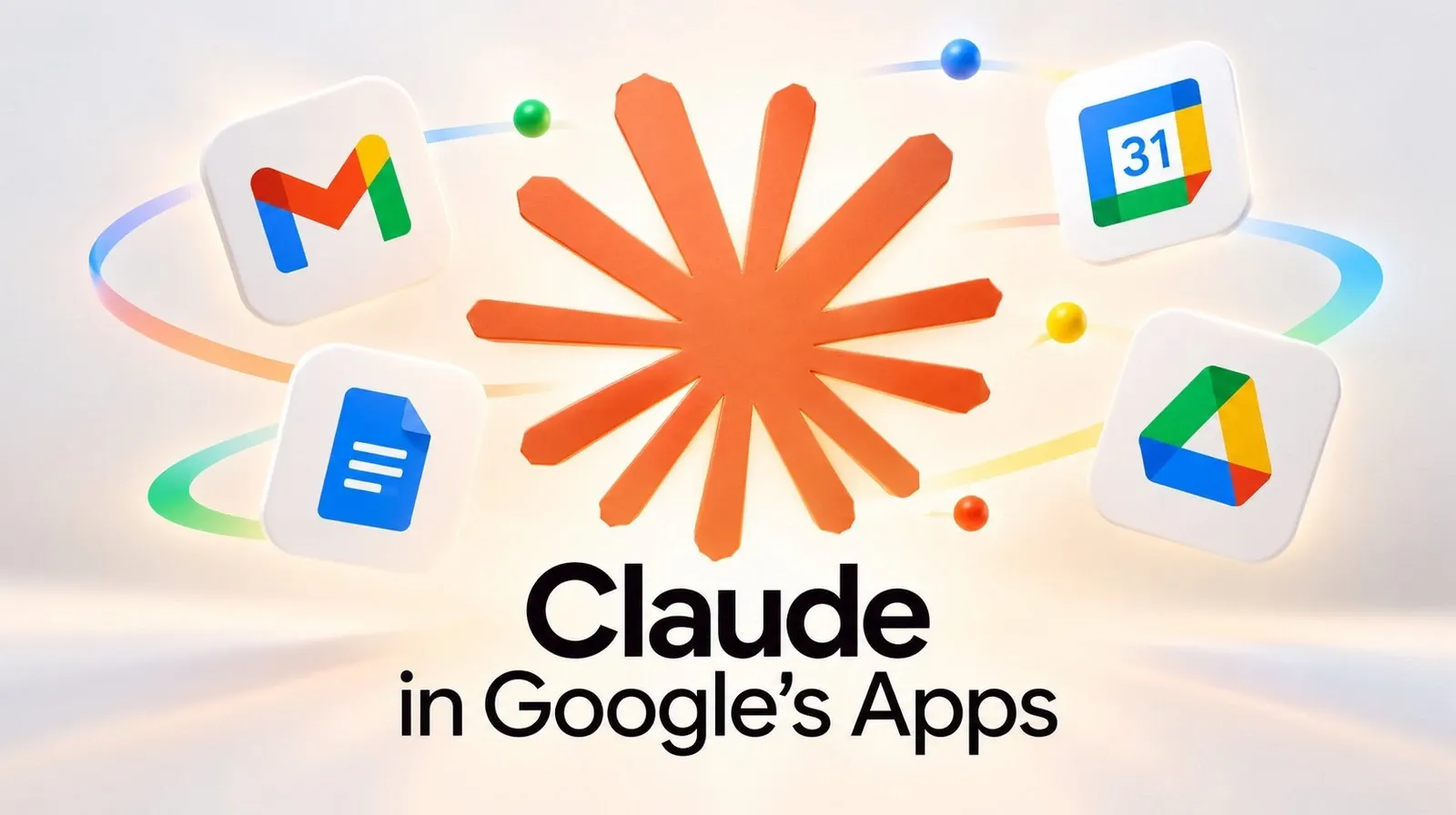
The integration of Claude AI into Google Workspace apps like Docs, Sheets and Slides offers practical solutions for handling everyday professional tasks. According to Your AI Workflow, one standout feature is Claude’s ability to analyze past communications to draft emails, organize shared files and create detailed meeting agendas. This functionality addresses common challenges in managing collaborative workflows, offering a reliable way to streamline repetitive processes. Discover how Claude AI enhances productivity across Google Workspace with task-specific features……..Continue reading…
By:
Source: Geeky Gadgets
.
Critics:
Claude is a generative AI chatbot. It sometimes uses artifacts, a feature introduced in June 2024 to generate and interact with code snippets and documents. In 2025, Anthropic added a web search feature to Claude. Claude Pro and Claude Max are subscription services for additional access to Claude models. Max provides higher usage limits at an additional cost. Grouped subscriptions include Claude Team and Claude Enterprise.
According to card-spend data from Ramp, the share of businesses on its platform paying for Anthropic products rose 4.9 percentage points in February 2026, to 24.4%, the largest monthly gain Ramp had recorded for the company. Claude is reportedly named after Claude Shannon, a 20th-century mathematician who laid the foundation for information theory.

A Claude feature allows users to share chats with anyone who has the link. In September 2025, Forbes reported that hundreds of shared Claude chats had appeared in Google Search results, following similar incidents involving OpenAI’s ChatGPT and xAI’s Grok. In July 2026, shared chats and Artifacts were again found to be indexed by Google.
The BBC counted more than 200, some containing health records and corporate documents. The affected chats were those whose links had been posted on the public internet. Technical analysis suggested that a robots.txt rule blocking crawlers from shared-chat pages also prevented them from reading the noindex directive meant to keep the pages out of search results. Anthropic said the listings had been removed.
Claude is also provided through an application programming interface (API). In October 2024, the “computer use” feature was introduced by which an application can call the Claude API to attempt to give navigational control of the application via Claude’s interpretation of screen content and simulation of keyboard and mouse input.
Claude Code, released in February 2025, is an agentic command line tool to delegate coding tasks from the terminal using natural language prompts. It was made generally available in May 2025 alongside Claude 4. Based on enterprise adoption, Anthropic reported a 5.5x increase in Claude Code revenue by July.
On October 20, 2025, Anthropic launched a web version of Claude Code and a sandboxing feature. Coinciding with performance improvements tied to Claude Opus 4.5, Claude Code went viral during the 2025–2026 winter holidays when people had time to experiment with it, including many non-programmers who used it for vibe coding.
In August 2025, Anthropic reported that cybercriminals it designated “GTG-2002” had used Claude Code in a data-extortion campaign against at least 17 organizations. In November 2025, Anthropic said that in September a China-based cybercrime group had used Claude Code to automate 80–90% of its espionage cyberattacks against 30 organizations.
Claude Code is used by Microsoft and Google, and was used by OpenAI employees until August 2025, when Anthropic revoked OpenAI’s API access, calling it “a direct violation of our terms of service”. In February 2026, Anthropic introduced Claude Code Security, which reviews codebases to identify vulnerabilities. In March 2026, the source code for the Claude Code command-line interface application was leaked, revealing multiple upcoming features and models.
In May 2026, Anthropic introduced “Dreaming”, a research-preview feature of its Managed Agents API that consolidates an agent’s persistent memory between sessions by merging duplicates and removing stale entries; a memory consolidation feature called autoDream had been identified in the March source code leak.
Claude Cowork is a tool similar to Claude Code but with a graphical user interface, aimed at non-technical users. It was released in January 2026 as a “research preview”. Cowork is available as a desktop application for Mac and Windows and through a web interface. It provides Claude with access to a sandboxed shell and to user-selected folders on the local file system, allowing the model to read, write and edit files, execute code, and chain multi-step tasks within a single conversation, such as organizing files on a user’s computer or generating documents from material in a local folder.
A Wall Street Journal reporter who tested the tool noted user concerns about granting an AI agent broad access to a personal computer. An early user reported that, after asking Cowork to organize the files on the desktop of his wife’s computer, it deleted all the family photos requiring the restoration of the images from an iCloud backup.
In February 2026, Anthropic announced a wider enterprise release of Cowork, adding connectors for services such as Google Drive, Gmail, Docusign and FactSet, and customizable plugins for domains including financial analysis, engineering and human resources.
The company described the update as a transition into an “enterprise-grade product”. In March 2026, Anthropic added Dispatch, which lets users send Cowork tasks from a phone to their computer, and allows Claude to operate programs on the user’s computer, such as web browsers or spreadsheet applications, to carry out tasks. According to developers, Cowork was mostly built by Claude Code.
Claude models are generative pre-trained transformers that have been trained to predict the next word in large amounts of text. Then, they have been fine-tuned using reinforcement learning from human feedback (RLHF) and constitutional AI in an attempt to enforce ethical guidelines.ClaudeBot searches the web for content. It was criticized by iFixit in 2024 for accessing their site over a million times a day to scrape content without permission, and also for the resulting excessive load on their system.
Anthropic introduced an approach to AI alignment called “Constitutional AI”. The constitution is a document used to train Claude to be harmless and helpful without relying on extensive or expensive human feedback. Time described this constitution as “somewhere between a moral philosophy thesis and a company culture blog post”.



Leave a Reply